

Seasonal wisteria work and surrounding garden care
Gardeners Sidcup
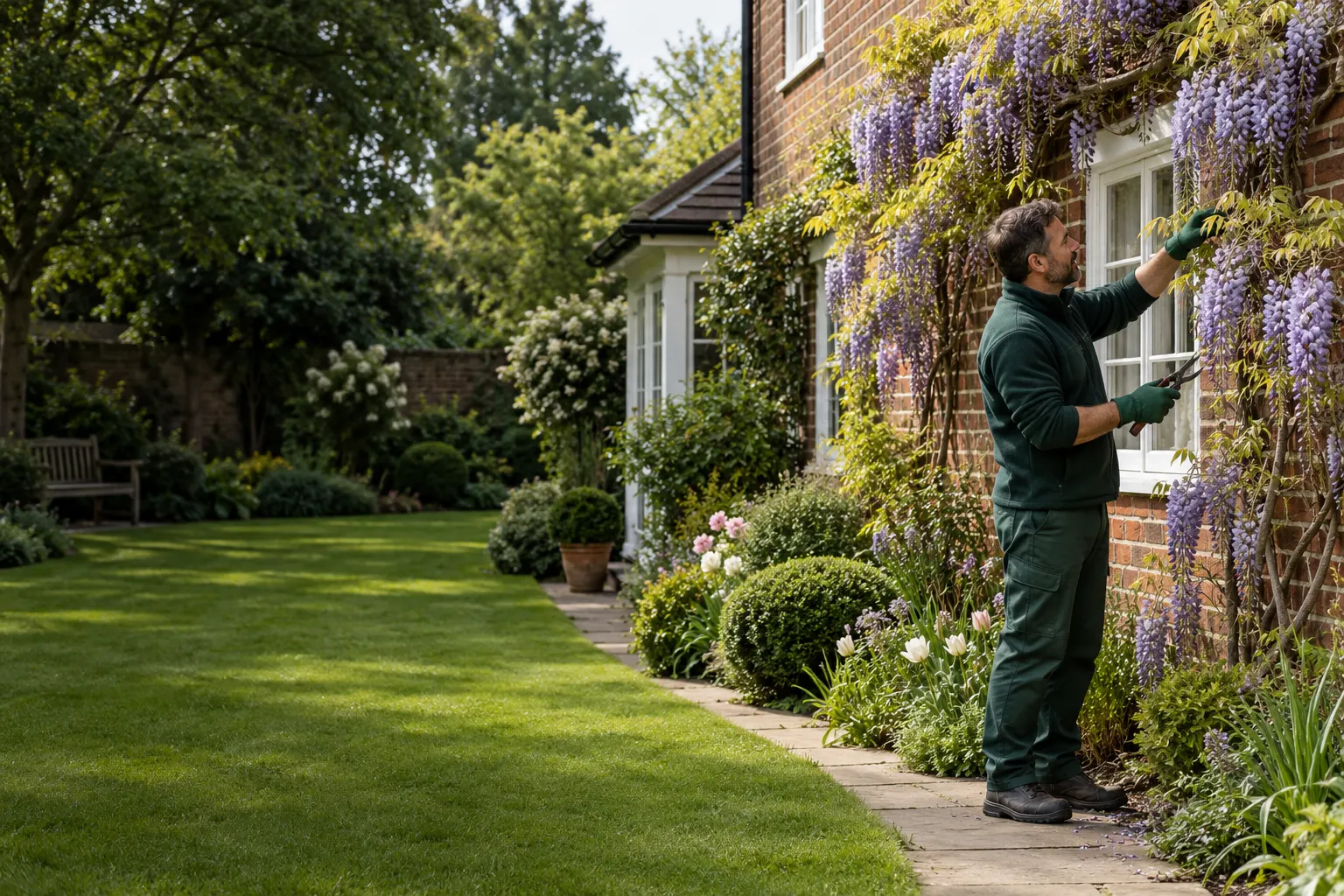
Our Sidcup gardening service includes suitable reachable wisteria pruning alongside maintenance of the lawn, borders and hedges. The work follows the plant's trained framework and the stage of its side shoots. We separate that seasonal operation from major renovation, then collect the removed growth and finish the surrounding surfaces, leaving the retained arrangement recognisable.
- How do your summer and winter cuts differ? Our suitable summer side-shoot work retains about five or six leaves; dormant pruning revisits those shoots at two or three buds.
- How does tree work account for existing cables? Our proposed branch work takes account of the installed bracing system and its connections before the tree's supported arrangement is altered.
Seasonal care of the trained plant
What does your seasonal wisteria pruning involve?
We identify the trained structure and suitable current-season laterals before selecting the summer cuts. The RHS approach retains about five or six leaves on those shoots, followed by two or three buds at the dormant stage. Our gardeners apply that sequence to the identified growth, keeping framework stems and useful extension separate from the side shoots receiving the seasonal treatment.
How do you distinguish routine pruning from renovation?
Reachable side-shoot work is planned around the existing trained stems, selected laterals and growth retained for extension. Heavy old wood, a tangled framework or growth crossing a roof can require a different operation. We distinguish those conditions from the seasonal job, so the customer receives a defined pruning treatment.
An identified framework for the pruning
Trained stems and selected laterals
The gardener follows the established trained line across its support before selecting newer growth for shortening. This establishes the relationship between the framework and the long leafy shoots extending from it. Each chosen lateral is traced back to its origin, giving the cut a clear reference within the plant. The resulting work manages the identified seasonal growth while preserving the arrangement that carries it across the growing space.
Extension shoots needed for the developing trained arrangement are kept distinct during that selection. A younger plant still filling its support can need a length that would be shortened on a mature arrangement. Our pruning reflects that stage instead of making every part uniformly short. This allows the continuing framework to remain understandable, with the retained growth serving its intended route and the selected side shoots receiving their own treatment.
A garden-maintenance visit can combine this identified pruning with the other reachable tasks around the plant. The initial review establishes which stems can be followed reliably and where the gardener can work in a controlled position. A dense tangle is resolved as a stem-selection problem before cutting proceeds. The seasonal operation remains distinct from support installation or major renovation of a heavy framework, keeping the actual service suited to the plant encountered.

A controlled summer pruning pass
Summer cuts are placed on the identified shoot
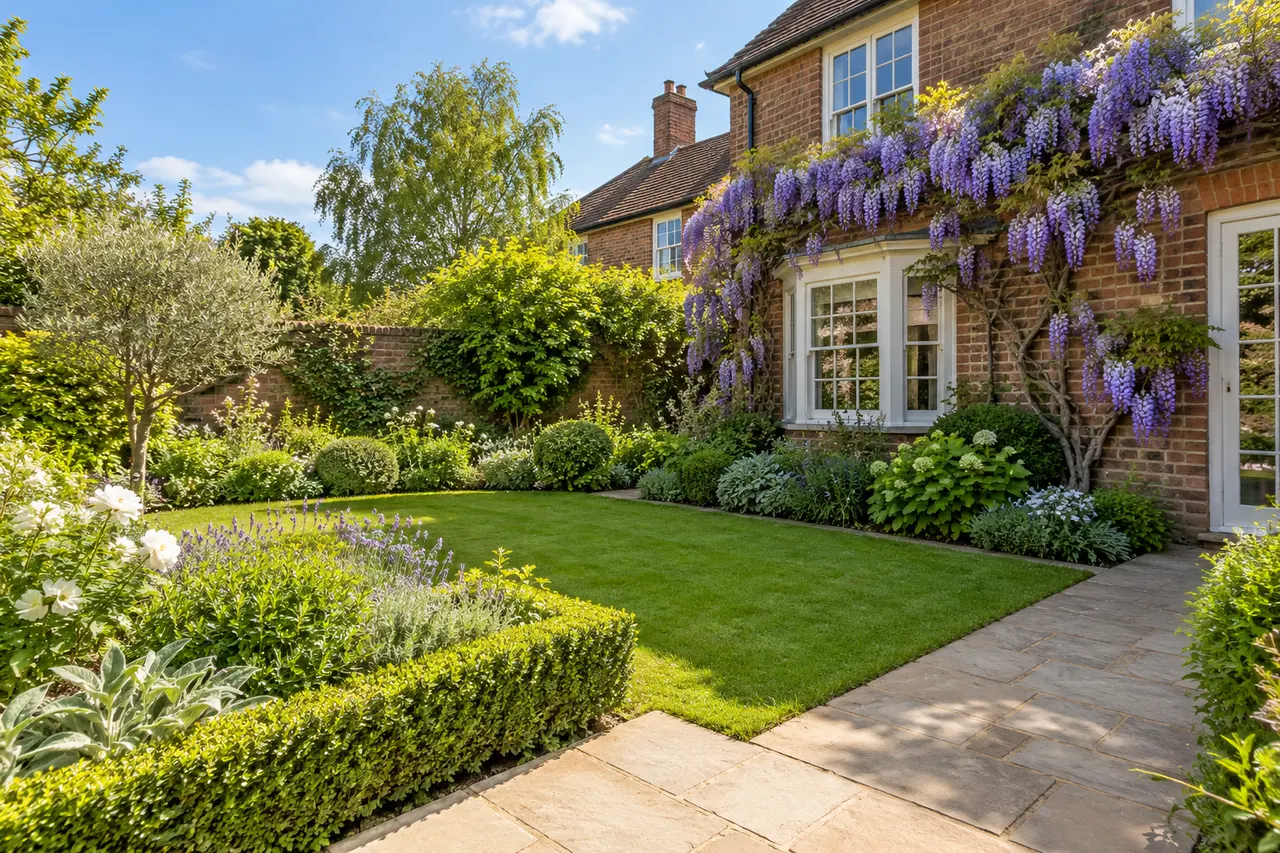
For suitable summer work, our gardener follows the current-season lateral from its framework and counts the retained leaves on that particular shoot. The RHS guide of about five or six leaves supplies a position within the growth. It is not converted into a fixed distance from the wall or a general trimming plane across the front of the plant. This gives each selected cut an understood relationship to the stem.
Crossing lengths are kept distinguishable while the cutting point is selected. The team follows the same shoot from its origin through the retained leaves, avoiding a count on one stem followed by a cut on another. The unwanted extension is removed with its connection understood. This controlled sequence leaves the remaining growth identifiable instead of producing a thinner-looking outline through repeated cuts into an indistinct bundle of stems.
Summer shortening manages the current extension while preserving its relationship to the trained structure. Our completed work leaves the selected spur arrangement recognisable for the later stage, with useful growth retained for its purpose. The appearance and treatment can be described accurately without attaching a flowering guarantee to the visit: plant maturity and growing conditions also influence the next display. The service provides the actual pruning operation, not a promised number of racemes.
- Identification of each lateral and its connection to the framework.
- Retention of the extension needed for the developing trained arrangement.
- Summer leaf counts applied to the actual selected shoot.
- Controlled separation of removed lengths from neighbouring retained growth.
- Dormant revisiting of the suitable shoots at their bud-count stage.

Mowing beside a woody climber
We clear the mowing strip without using it to prune
Our lawn preparation identifies wisteria lengths that have reached the grass beneath or alongside the support. The gardener distinguishes an attached shoot from a disconnected piece before the mowing route is opened. Connected growth receives the appropriate pruning or retention treatment first. This prevents the grass-cutting operation from pulling on the climber and keeps the selected framework growth separate from material already ready for collection.
The lawn care then follows the suitable grass surface with loose cuttings removed from the machine's strip. Our team keeps the mower clear of woody extensions and retained training shoots, finishing the lawn around the plant's actual outline. The grass receives its cutting pass once that relationship has been established, so the service produces a maintained lawn beside a deliberately pruned climber.
A horizontal stem can disappear beneath longer grass while remaining attached to the support above. We follow that connection at the boundary before gathering or cutting the growth. The preparation therefore addresses both the visible lawn and the retained stems crossing it. Keeping those parts distinguishable throughout the operation avoids a second, unintended removal when the ground is collected, and leaves the remaining plant ready for its continuing trained development.
Collection following the selected cuts
Controlled withdrawal of the disconnected lengths
The length being removed is checked for remaining entanglement before it is drawn out. Wisteria can wind around neighbouring stems and fittings, so a cut end may still be threaded through the retained arrangement. Our collection follows those connections and releases the selected material with controlled handling. This removes the product of the pruning while keeping the surrounding stems and their fittings outside the pulling movement.
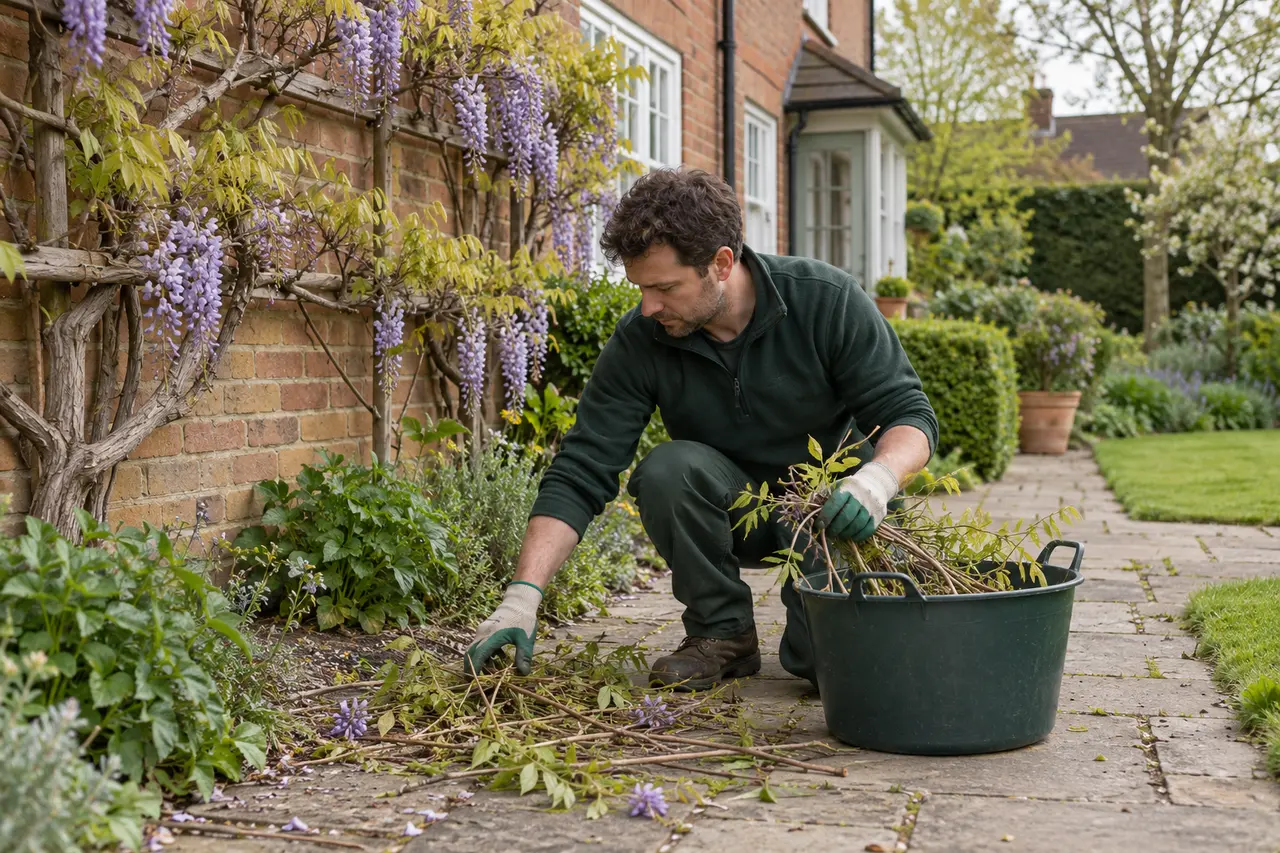
The related garden clean-up gathers the detached lengths into the outgoing material included in the service. Living shoots remain distinguishable while that load is formed. Where loose cuttings need further shortening for handling, the team works on those identified pieces. The finish removes the disconnected growth without extending the pruning into parts of the plant that were selected to stay.
Our handling of garden cuttings keeps long trailing pieces from remaining stretched across the working route. Gathering follows the completed cuts, with manageable lengths brought together for the stated destination. This also leaves the floor beneath the plant available for its final check and surrounding maintenance. The customer's retained trained arrangement is kept intact as the material leaves it.
Separate care where planting overlaps
Climber pruning and hedge trimming follow different outlines
Where wisteria has entered a neighbouring hedge, the team identifies its shoots before either plant is cut. A climbing lateral threaded through foliage needs its own connection and cutting position understood. Our work follows it back to the parent plant. This makes the overlapping area manageable without allowing the hedge's trimming line to determine the climber's treatment.
The two services can be combined within a visit while retaining their different methods. Hedge trimming follows the hedge's species, growth and intended outline; the wisteria operation follows its trained framework and seasonal selection. Our gardeners separate those requirements even where the leaves occupy the same space. The resulting finish respects both plants.
Nest checks apply to the interwoven growth as well as the obvious hedge face. We postpone affected work where a nest is being built or used, including any pulling of stems that would disturb it. This constraint remains part of the working method throughout the overlapping section. The team can retain the planned pruning purpose without forcing access through occupied growth simply to continue the next movement of the job.

The dormant follow-up operation
Winter work revisits the selected summer shoots
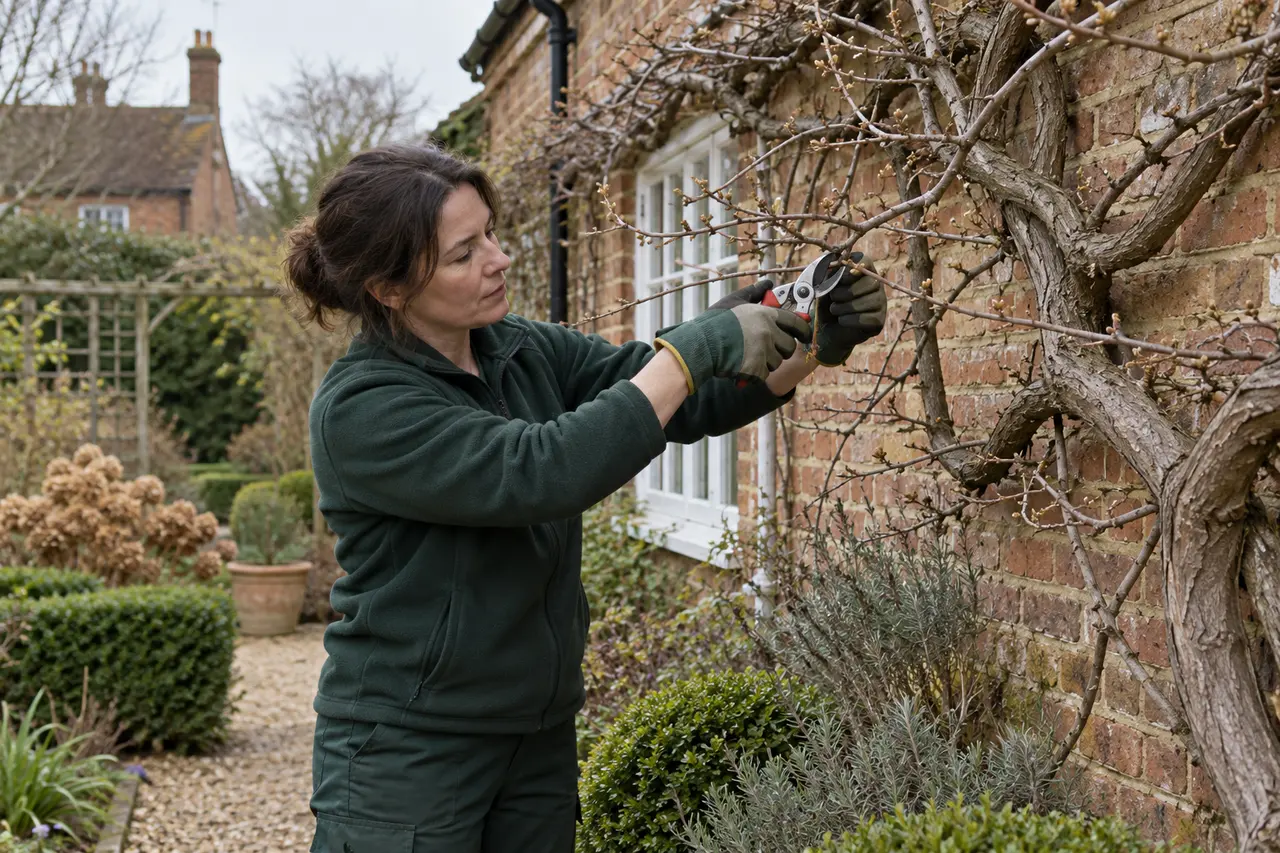
At the suitable dormant stage, our gardeners revisit the laterals shortened in summer and count the two or three retained buds used in the RHS approach. The count follows the identified shoot, with the trained framework and reserved extension kept separate. This is a different cutting reference from the summer leaf count. The completed winter work leaves the shorter spur positions in a deliberate relationship with the retained stems.
The more open view after leaf fall helps the team recognise trained lines and previous pruning points. Our winter pass distinguishes the old framework from the laterals selected for shortening, so visible woody growth is not removed merely because it is exposed. That separation keeps a seasonal visit within its intended task. A larger renovation remains a different operation.
Within the garden's seasonal upkeep, the summer and winter stages retain a useful continuity. The work performed and extension left for training remain identifiable for the next appropriate pass. A missed stage is assessed from the actual growth now present. This gives the customer an account of the treatment and the retained structure that can guide continuing care.
Other garden services alongside the pruning
Designing a clear view through the trained planting
Our garden design can define a view through a climber framing a window, gateway or opening. That opening is part of the arrangement, with the plant's development considered around it. The design does not depend on filling every part of the support and repeatedly removing a new hole afterwards. A clear intended line of sight gives later maintenance a useful reference, connecting the trained growth to how the space is viewed and used.
Tree work that accounts for an installed brace
An existing cable or brace can have a structural role within the tree. Our proposed tree surgery takes account of its connections before a branch is removed or its load altered. The installed system is distinguished from loose garden wire, keeping its relationship to the retained tree within the work plan. This is relevant to the actual cutting operation: changing a connected part can affect the arrangement supporting the remaining growth.
Pressure washing with the intended spray pattern
During jet washing, an irregular spray pattern prompts an appropriate equipment check. A partly obstructed nozzle can change the pattern, so greater force against the paving is not treated as the answer to the resulting mark. The equipment is stopped and isolated under the maker's instructions before the nozzle is addressed. Our aim is controlled contact with the surface using the intended spray.
Gutter clearing within the available roof-edge gap
Our gutter cleaning method takes account of entry beneath the roof edge as well as the height of the channel. A pole can reach the elevation while its attachment still lacks a suitable opening under an overhanging tile. The working geometry therefore influences the approach selected for that run. Roof components are not lifted or the attachment forced into place simply to overcome a gap too restricted for the equipment.
Supported handling of the pot-grown tree
Our pot-grown Christmas-tree delivery preparation distinguishes the growing container from any separate decorative cover. The planted rootball needs appropriate support during handling; a loose outer pot is not automatically a load-bearing part of the item. Handling follows the actual container, tree and weight, with the stem and branches kept out of the lifting method. This gives the handover a suitable approach for a rooted plant.
Rates for reachable seasonal pruning
Use these general gardening guide rates when discussing suitable reachable pruning and the surrounding tasks. Major renovation and other separately assessed work need their own scope.
| Gardening time | Guide rate |
|---|---|
| First hour | £83 |
| Each subsequent hour | £65 |
GBP guide rates. Confirm the complete quotation, materials, outgoing cuttings, VAT treatment and any applicable parking, congestion or access charges.
Questions about our wisteria maintenance
How is extension growth protected during the pruning?
We identify shoots needed to develop the trained plant before selecting ordinary laterals for shortening. That retained length can be important while the arrangement is still filling its support. Our pruning therefore preserves the intended framework and development, with the seasonal cut applied to the appropriate side shoots.
How do your gardeners treat shoots below a graft?
Their origin is identified before a cutting method is selected. A shoot below the graft may be rootstock suckering rather than growth of the chosen trained variety. Our treatment follows that distinction, instead of retaining it automatically as a flowering spur or applying the ordinary leaf-count shortening. The seasonal lateral method remains tied to suitable shoots arising from the intended framework.
How is wisteria around a downpipe handled?
We distinguish an existing entanglement from suitable training support. Vigorous twining growth thickens as it develops and can affect fittings it encircles, so it is not directed around a downpipe as a support substitute. Heavy growth already caught around the building receives a considered approach; our work does not pull it away merely to release a newer shoot from the same area.
What result does the pruning service provide?
The service provides the specified seasonal growth management, with the cuts performed and the retained framework identifiable afterwards. Flowering remains dependent on the plant and its conditions as well as suitable pruning. Our account of the visit therefore describes the actual treatment and continuing growth, giving the customer a realistic maintenance result without substituting a promised flowering display for the work carried out.
Continuity between the two pruning stages
Our seasonal gardening in Sidcup carries the identified laterals forward from summer into the dormant pass. Extension retained for the trained arrangement stays distinguishable from the shoots being revisited. That continuity gives the following operation a clear starting point, keeping the established framework and completed seasonal work understandable instead of repeatedly beginning with an undifferentiated mass of growth.